Coordinateurs du projet
Context
Experimental modeling of the behavior of a floating wind turbine in a tank requires overcoming several challenges in order to represent as accurately as possible the influence of the rotor on the entire structure. The physical phenomena and forces caused by wind and waves are not governed by the same laws of similarity. While the drag and lift coefficients of the blades are highly dependent on the Reynolds number, hydrodynamic forces are dictated by the Froude number. This incompatibility often requires modeling compromises. The development of the SOFTWIND device will overcome similarity issues and provide a robust and accurate device in terms of both hydrodynamics and aerodynamics.
WEBINAR on the SOFTWIND project—July 2020
Scientific breakthroughs and innovation
One of the main challenges here is to get the software and the actuator to communicate quickly enough. This requires a digital model that is fast enough, but also the most efficient information transfer chain possible. This constraint is not always met, and some experimental devices respond with a delay that can alter the behavior of the system. The members of the SoftWind project have identified this obstacle and will propose an original solution to overcome it. The originality of this solution will come in part from the involvement of automation engineers who are interested in offshore wind power, whereas at the national level, the automation engineering community is not involved, or only minimally involved, in this area. The originality of the approach compared to the state of the art will also come from taking into account the inertial forces of the rotor through a system of rotating weights.
Expected technical and economic impact
The development of the SOFTWIND device will lead to advances in our understanding of the behavior of floating wind turbines and the influence of control systems on their dynamics. The development of the SOFTWIND experimental platform, coupled with a wave basin, will enable developers and academics to validate their work more accurately and thus accelerate developments, particularly with regard to optimizing the trade-offs between stability, structural aging, and electricity production.
Demonstrator
Experimental platform dedicated to testing floating wind turbines using a software-in-the-loop approach.
Results
A test bench with a single actuator was tested from December 2018 to January 2019. The purpose of this installation was to validate:
- communication protocols,
- real-time execution of the digital model,
- motion and force observers,
- preliminary identification of the actuator model.
The preliminary validation tests consist of movements imposed by means of a hexapod (see figure below) and will be followed by wave tank tests in September.
 Figure 1: Experimental device currently used for the validation of communication protocols
In October 2019, the SOFTWIND emulation system was used in the H2020 Blue Growth Farm project (see Fig. 2).
 Figure 2: SOFTWIND device installed on the Blue Growth Farm platform.
From December 2019 to March 2020, several basin tests were carried out to validate and evaluate the performance of the entire emulation system. Thanks to its good performance, initial tests were conducted to validate the rotor control laws developed by D-Ice Eng. and the LS2N laboratory.

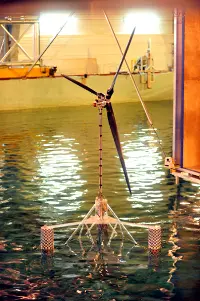
Figure 3: SOFTWIND device installed on a spar-type platform for testing rotor control laws.
Publications and presentations produced
Thesis
- 2020-Modélisation expérimentale d’une éolienne flottante par une approche « software-in-the-loop »-Centrale Nantes-Vincent ARNAL, 11 décembre 2020
Oral communications
- Poster SOTWIND, V Arnal, JC Gilloteaux, F Bonnefoy, S Aubrun. French American Innovation Day à Boston 18-19 mars 2019.
- Research investigations on multi physic and multiscalekey topics for floating wind turbine behavior, Aubrun S, Gilloteaux JC, Kerkeni S, Lynch M. FOWT, April 24 26 2019
- Hybrid model testing of floating wind turbines, V Arnal, JC Gilloteaux, F Bonnefoy, S Aubrun.15 th EAWE PhD seminar , Nantes, 29-31 octobre 2019.
- Hybrid model testing of floating wind turbines : test bench for system identification and performance assessment. V Arnal, JC Gilloteaux, F Bonnefoy, S Aubrun. 38th International Conference on Ocean, Offshore and Arctic Engineering (2019).
- Wave tank model testing of floating wind turbines: reproducing aerodynamic loads. V. ARNAL, JC GILLOTEAUX, F BONNEFOY, S AUBRUN. GP5 de l’Ancre, En ligne, Octobre 2019
- Hybrid model testing of floating wind turbines, V Arnal, JC Gilloteaux, F Bonnefoy, S Aubrun, WESC – 2019
- Effects of platform motions on FOWT rotor performances, JC GILLOTEAUX, S. AUBRUN, F. BONNEFOY. EERA JPWind, Octobre 2020, en visio conférence.
- Influence of wind turbine thrust modelling methodology on global motions, V. ARNAL, JC GILLOTEAUX, F. BONNEFOY, S. AUBRUN. Les Journées de l’Hydrodynamique » En ligne, 26 Novembre 2020.
- Software in the Loop testing of FOWT: assessment of performance and elements of design regarding SOFTWIND experimental set-up, BONNEFOY F., ARNAL V., GILLOTEAUX J.-C. WESC. En ligne, Mai 2021.
Perspectives
Following this project, the objective will be to set up collaborative projects with French or foreign academic and industrial partners in order to respond to calls for European (H2020, OCEANET, etc.) or national (ANR FEM, ADEME, etc.) projects.